Note: This article is written based on my investment stance as of July 2026.
"Why am I paying a fee just to access my own money?"
Looking back, my journey of taking personal finance seriously started with this tiny spark of frustration.
While managing assets and investing has now become one of my favorite hobbies, I used to be completely indifferent to money. I had zero interest in saving or investing, blindly believing the old advice of "just keep your money in savings."
In this article, I want to share how I reviewed my relationship with money, went through various mistakes and detours, and finally arrived at my current investment style.
Bank Fees Were What Finally Made Me Pay Attention
Growing up, I was always told to "put your money in savings." At the time, that was the standard advice, and I never thought to question it.
But times have changed. With ultra-low interest rates, the interest on standard bank deposits is practically microscopic, while ATM and transfer fees are still deducted mercilessly.
I remember it was around the time ATM fees hiked from 200 yen to about 400 yen. Looking at my statement, I thought, "Wait, it costs 400 yen just to withdraw 10,000 yen?! That's ridiculous." That got me quietly fuming, and I immediately started looking for ways to improve my household finances.
- Switching to online banks
- Streamlining my credit cards
- Utilizing point rewards
- Reviewing recurring bills (mobile, internet, electricity, gas)
- Tracking my budget with apps like Money Forward
As I took action and adjusted things one by one, I realized how much you can save just by taking a little time to look into it.
The Experimental Phase: From Robo-Advisors to FX and Margin Trading
Improving my household budget naturally led to an interest in investing.
I think it all started when robo-advisors like THEO and WealthNavi first emerged around 2016. I read a blog post explaining how they automatically manage your portfolio based on solid investment principles, and it just made sense to me. I signed up and deposited a small amount of money to start.
I remember feeling a unique kind of excitement watching my money increase or decrease daily, completely unrelated to my own labor or effort.
Watching my assets actually move made me think, "Hey, I could probably open a brokerage account and do something similar myself for cheaper." So, I opened an account with SBI Securities and started buying index funds.
From there, driven by curiosity and a desire for higher returns, I ended up trying almost everything: individual stocks, margin trading, FX, and automated trading systems.
Getting Burned by the VIX Shock
Everything was going smoothly, but the turning point came with the VIX Shock in 2018. I suffered a painful loss with VIX Inverse ETNs that I held through margin trading.
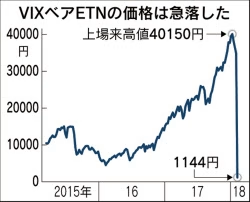
While the financial loss itself was painful, what hurt more was the realization: "I took on huge risks with a complex financial instrument that I didn't truly understand." It was a humbling experience.
After that, I liquidated all my robo-advisors, FX, and automated systems, keeping only my monthly index fund contributions. I decided to take a step back from trying too hard with investing.
Discovering the "99% is Good Enough" Approach
Later on, I came across the concept of simple, index-centric investing, inspired by things like Hayato Ito's article, 「普通の人が資産運用で99点をとる方法とその考え方」 (How Average People Can Achieve 99% in Asset Management and Its Concept).
I deeply agreed with the idea that if you only care about building wealth, simply buying index funds and leaving them alone is truly all you need. Having gone through that long detour and painful failures, this simple, rational approach clicked perfectly.
However, I decided not to go 100% into All-Country World Index (known as "Orcan" in Japan). While I fully acknowledged its logic, I still wanted to enjoy the process of investing itself.
Knowing My Money Came Before Choosing Investments
Around the time the "99% is good enough" idea clicked for me, I also started caring less about finding the perfect investment product and more about understanding my finances as a whole.
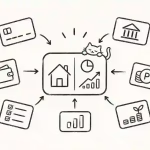
I link my banks, brokerage accounts, credit cards, and point systems into Money Forward. That gives me a quick view of my total assets, cash flow, and asset allocation whenever I need it.
Once the whole picture is visible, it becomes much easier to think about how much money can reasonably be invested and how much volatility I am actually prepared to tolerate. During the VIX Shock, I was focused mostly on the product in front of me and the returns it promised. Now I look at my overall finances first, then decide how much risk makes sense within that picture.
After taking the long way around, I came to see this visibility as more important than hunting for the next interesting product.
And honestly, watching my assets grow over time is also pretty good for my peace of mind.
Arriving at My Current Investment Style
That is the foundation of the investment style I use today:
- Core: Global equities (Orcan) as the main engine, alongside index contributions to Gold and FANG+ (using NISA tax-free accounts and credit card auto-investments).
- Satellite: High-yield ETFs (like the Tokyo Stock Exchange listed QYLD) using covered call strategies.
- Satellite: Individual Japanese stocks for shareholder benefits (Yutai).
- Satellite: Margin trading, within a deliberately limited risk budget.
The core stays simple. The satellite side gives me the enjoyment and flexibility I would miss in an all-index portfolio. I also use margin trading occasionally, but only after looking at my overall assets and cash flow and deciding that the potential loss is within a range I can accept.
You might wonder, "Why go back to margin trading after getting burned so badly?"
The difference is not that I now think margin trading is safe. It is that I now know how much risk I am taking within the portfolio as a whole, set rules before entering a position, and keep the exposure within limits I can manage. Because I understand the mechanism better now, I am willing to use the available margin selectively rather than treating it as something that must either be maximized or avoided entirely.
Choosing My Own Stance Over Someone Else's "Correct" Answer
Looking back, my relationship with money has been a constant series of trials, errors, and upgrades.
From savings, robo-advisors, FX, individual stocks, and margin trading, to index funds—I never blindly accepted or rejected any of them. I tried them, made mistakes, and only kept what made sense to me.
Therefore, this investment style might change in the future. Market environments change, new products will emerge, and my own stage of life will evolve.
Even so, the one thing I know won't change is my attitude: "Understand what I invest in, and make choices that I am personally comfortable with."
Instead of borrowing someone else's "perfect" strategy, I want to keep choosing the answers that feel right for me at that moment. That is my current relationship with money and my investment stance.