Is Switching Everything to 5.5 the Right Call?
In April 2026, OpenAI released the GPT-5.5 series (OpenAI's GPT-5.5 announcement).
While marketed as "smarter and more token-efficient," hands-on experience in daily development work has shown that it's not a universal upgrade for every use case. In particular, when maintaining existing codebases, GPT-5.4 can actually be more cost-effective in certain scenarios.
This article compares the two models based on real-world usage and explores how to choose between them depending on your project phase.
Context and Background
GPT-5.5 comes with an API price tag twice as high as GPT-5.4 for the standard model. In their GPT-5.5 announcement, OpenAI states that the model is designed to complete the same tasks with fewer tokens, theoretically improving overall efficiency.
However, "efficiency" is highly contextual. The model behaves quite differently when building something from scratch versus refactoring a complex, existing codebase.
Key Differences (Comparison Table)
Here's a comparison of the primary specs and costs. Note that all three models share a 1M token context window, so that row is omitted from the table.
| Metric | GPT-5.4 | GPT-5.5 (April 2026–) | GPT-5.5 Pro |
|---|---|---|---|
| Input (per 1M tokens) | $2.50 | $5.00 | $30.00 |
| Output (per 1M tokens) | $15.00 | $30.00 | $180.00 |
| Token Efficiency (subjective) | Standard | High (summarization/reasoning) | Best (complex logic) |
| Best For (author's assessment) | Minor fixes, repetitive tasks | New builds, large-scale summaries | Architectural overhauls |
Verdict: When to Use Which?
After spending several days testing both models on greenfield and brownfield projects shortly after the April 2026 release, a clear boundary for strategic use emerged.
GPT-5.5 excels at — Building new projects from scratch
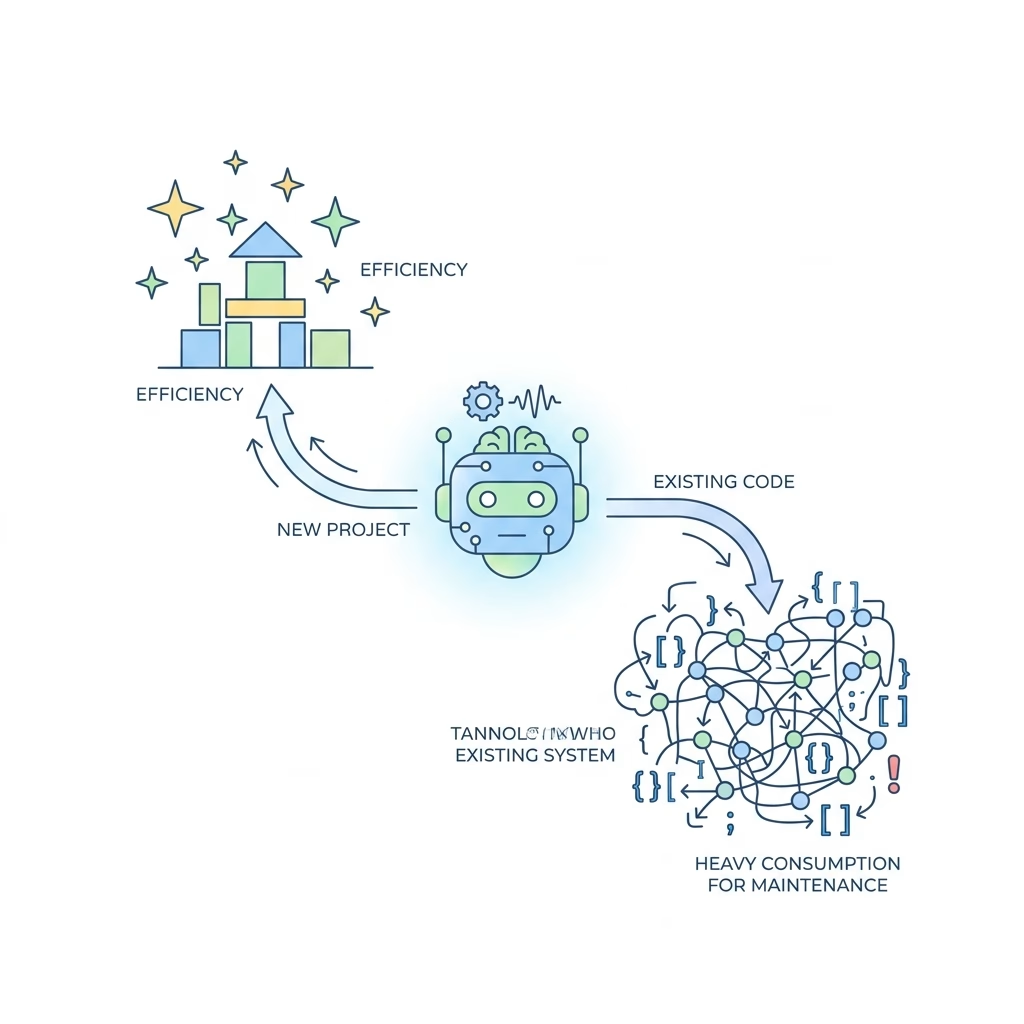
When delegating everything from architectural decisions to generating large chunks of initial code, GPT-5.5 tended to produce code aligned with intent in fewer back-and-forth exchanges. It grasps full context without requiring finely broken-down instructions, which reduces the number of iterations and ultimately saves time and total cost.
GPT-5.4 excels at — Routine maintenance of existing codebases
Since the unit price of GPT-5.5 is double that of 5.4, the efficiency gain must be massive (more than 2x) to break even. For simple tasks, this is rarely the case.
When tasked with applying specific fixes to existing code, GPT-5.5 consumed more tokens in several instances. Its tendency toward deeper reasoning seems to produce more verbose outputs and spend additional tokens on context re-validation for tasks that don't require it.
For straightforward "fix just this" requests, the cheaper and more predictable GPT-5.4 results in lower overall token usage and cost.
Summary
GPT-5.5 is a clear step forward from 5.4 in reasoning depth and agentic behavior. For prototyping or designing new features—situations where you need to go from 0 to 1, or rapidly scale from 1 to 10—the performance gains easily justify the higher cost.
However, for daily maintenance and small refactors within established project rules (Day 2 operations), GPT-5.4 delivers better cost-performance in many scenarios.
Rather than switching everything to 5.5 just because it's newer, a phase-based approach of "5.5 for new builds, 5.4 for maintenance" seems to be the pragmatic choice as of June 2026.
That said, manually deciding which model or reasoning level to use for every single task is inherently inefficient. I'd love to see a "Full Auto Mode" where the AI itself analyzes the context and intent to automatically select the most cost-effective model for the job—half complaint, half genuine anticipation.