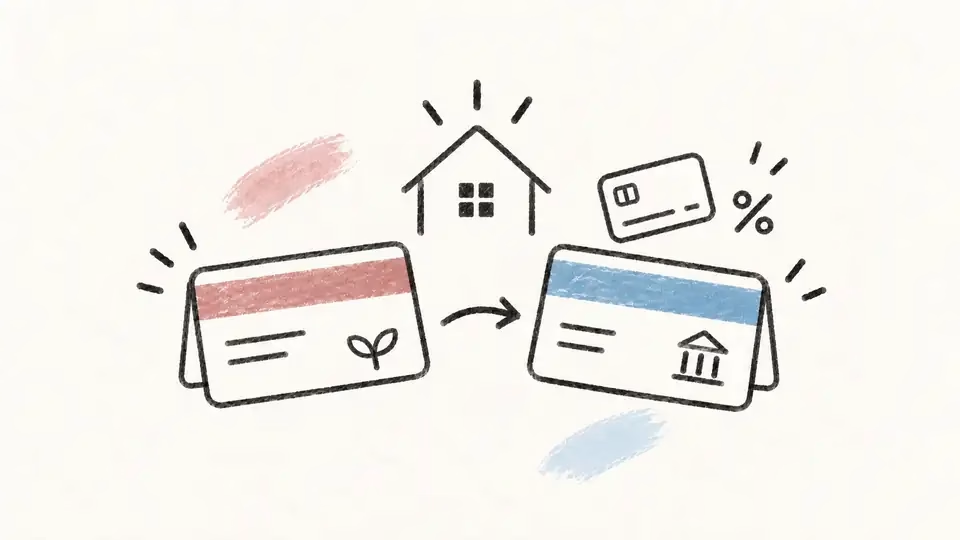
I had been vaguely curious about the Mizuho Rakuten Card for a while. It is positioned as a Mizuho Bank card, yet the issuer is Rakuten Card. That combination felt a little unusual.
Our household finances are currently built around Rakuten Bank and Rakuten Card. If this were just my own card, I might have tried switching much sooner. A household card is different. It means asking my spouse to change cards too, aligning payment methods, and keeping the statement management easy for both of us.
Adding only the Mizuho Rakuten Card would also mean moving money to Mizuho Bank every month just for the card withdrawal. Until recently, that felt like too much friction for one more card.
That changed when the point structure was strengthened in September 2026. In addition to the usual 1% Rakuten Points, eligible card spending now earns the same number of Mizuho Points, making everyday card spending worth up to 2% in total.
At 2%, the calculation changes. Rather than adding a card and manually moving cash around, it may be cleaner to move the household main account itself to Mizuho Bank. So I compared it again with Rakuten Bank.
For my own usage, the move now looks surprisingly reasonable. Rakuten Bank is still a strong bank, but our household account was not really using its strongest advantages.
This article is based on official information available as of September 2026. Campaigns change quickly, so I focus mainly on the basic specifications.
The trigger was everyday spending becoming worth up to 2%
The Mizuho Rakuten Card is a no-annual-fee card issued by Rakuten Card. Its withdrawal account must be a Mizuho Bank account.
From September 2026, regular card spending earns 1% in Rakuten Points plus the same number of Mizuho Points. For every 100 yen spent, that means 1 Rakuten Point and 1 Mizuho Point, or up to 2% in total.
Mizuho Points can be exchanged for Rakuten Points at a 1:1 ratio. They can also be exchanged for PayPay Points, d Points, Amazon gift cards, and other options at roughly 1 point = 1 yen. Because of that, I do not think the Mizuho Point portion needs to be heavily discounted just because it is not Rakuten Points from the start.
There is still some friction. The points do not automatically become Rakuten Points, so an exchange step is required. Spending categories that are excluded from Rakuten Card points, or that have a reduced Rakuten Card point rate, are treated similarly for the Mizuho Point portion.
Even with that caveat, moving household spending from 1% to up to 2% is a meaningful difference. If 100,000 yen per month of spending qualifies, the extra return is about 12,000 yen per year. At 200,000 yen per month, it becomes about 24,000 yen per year.
For a household account, that difference can matter more than a small gap in savings account interest rates.
Rakuten Bank has a strong savings rate, but our household was not really using it
As a bank, Rakuten Bank still has an attractive savings rate.
Rakuten Bank ordinary deposits earn 0.40% per year under the basic rate. If Rakuten Card payments are withdrawn from the account, the rate becomes 0.42%. With Money Bridge, the rate on balances up to 10 million yen becomes 0.48%.
Mizuho Bank's ordinary deposit rate has been 0.40% per year since August 2026. If you keep a large amount of cash in ordinary deposits and use Money Bridge fully, Rakuten Bank has the advantage.
My case is different. Rakuten Bank is our family household account. It is not where I keep a large pool of cash waiting to be moved into Rakuten Securities. Most of the money going into Rakuten Securities now goes through credit card investment. That means the Money Bridge advantage is not doing much work inside the household account.
The gap between 0.48% and 0.40% is 0.08 percentage points before tax. That is 800 yen per year on 1 million yen, or 2,400 yen on 3 million yen. If the household account does not hold a large cash balance, the extra card rewards can easily outweigh the interest-rate difference.
Rakuten Securities card investment is also stronger with Mizuho Rakuten Card
Because I use Rakuten Securities, I initially assumed that keeping Rakuten Bank as the main account would be the natural choice.
But the main way I fund Rakuten Securities now is through credit card investment. On that specific point, Mizuho Rakuten Card has the better reward rate.
For low-cost funds with an agency fee below 0.4% per year, regular Rakuten Card investment earns 0.5% in Rakuten Points. With Mizuho Rakuten Card, the same 0.5% worth of Mizuho Points is also added, bringing the total to up to 1%.
For eligible funds with an agency fee of 0.4% or higher, the total can be up to 2%: 1% in Rakuten Points and 1% in Mizuho Points.
If you invest 100,000 yen per month into low-cost funds, the difference from a regular Rakuten Card is about 6,000 yen per year.
Rakuten Bank is convenient if you frequently move cash in and out of Rakuten Securities. If credit card investment is the main path, as it is for me, there is much less reason to keep the household account at Rakuten Bank just because the brokerage is Rakuten Securities.
Losing Rakuten Bank SPU hurts a little, but chasing SPU has become tiring
Mizuho Rakuten Card still qualifies for the Rakuten Card SPU benefit of +1x on Rakuten Ichiba. That part is the same as a regular Rakuten Card.
What disappears is the Rakuten Bank SPU. If Rakuten Card payments are withdrawn from Rakuten Bank, Rakuten Ichiba spending receives +0.3x. If salary, bonus, or pension payments are also received there, another +0.2x is added, for a total of up to +0.5x.
That is a little painful.
Even at +0.5x, however, the annual value is about 1,800 points if Rakuten Ichiba spending is 30,000 yen per month, or about 3,000 points at 50,000 yen per month. If non-Rakuten household card spending is large, the additional 1% from Mizuho Rakuten Card can cover that fairly easily.
The bigger issue for me is the effort of continuing to optimize SPU conditions.
There was a time when thinking through a combination for another +0.5x felt enjoyable. Recently, every change in service terms makes that optimization feel heavier. A simple up-to-2% return on everyday card spending now feels easier than nudging Rakuten Ichiba's multiplier a little higher.
Stepping slightly away from maximizing every corner of a point ecosystem may be part of the appeal of this switch.
Transfers and ATMs look good enough for household use
A strong card reward rate is not enough if the bank account itself is inconvenient. Transfers and ATMs matter for a household main account.
| Item | Rakuten Bank | Mizuho Bank |
|---|---|---|
| Ordinary deposit rate | 0.40% per year | 0.40% per year |
| Main rate benefits | 0.42% with Rakuten Card withdrawal; up to 0.48% with Money Bridge | No major permanent uplift found |
| Domestic transfer fee to other banks | Usually 145 yen; up to 3 free transfers per month through Happy Program | 110 yen via Mizuho Direct; 3 free transfers per month with eligible benefits |
| ATM benefits | Up to 7 free transactions per month through Happy Program | Free time-of-day fees at Mizuho and AEON Bank ATMs; 3 free E-net ATM transactions per month, and more |
| Physical branches | None | Available |
| Regular card rewards | Rakuten Card 1% | Mizuho Rakuten Card up to 2% total |
Rakuten Bank's Happy Program offers up to 7 free ATM transactions and up to 3 free transfers to other banks per month depending on balance and transaction count. It is very convenient if you often use convenience-store ATMs.
Mizuho Bank can provide Mizuho Mileage Club S Stage benefits through Mizuho Rakuten Card usage. This includes free usage and time-of-day fees at Mizuho Bank and AEON Bank ATMs, up to 3 free E-net ATM transactions per month, and up to 3 free transfers to other banks via Mizuho Direct.
Once the free allowance is used, Mizuho Direct transfers to other banks cost 110 yen.
Rakuten Bank has the edge if you use ATMs many times every month. If a household only needs around three bank transfers per month, Mizuho looks good enough.
Foreign-currency receipt is similar, while overseas remittance favors Rakuten Bank
I also checked foreign-currency handling because I sometimes use overseas services.
For receiving foreign-currency remittances from overseas or from another domestic bank, Rakuten Bank charges 2,450 yen per receipt. Mizuho Bank charges 2,500 yen for individuals, so this part is almost the same.
Sending money overseas is different. Rakuten Bank's overseas remittance fee for individuals is 750 yen. If the sender pays intermediary bank charges, another 1,000 yen is required. Yen-denominated remittance adds 3,000 yen.
Mizuho Bank's overseas remittance is more expensive than Rakuten Bank's. If you send money overseas often, keeping Rakuten Bank makes sense.
That does not mean Rakuten Bank needs to remain the household main account. It can stay as a sub-account for the cases where it is clearly better.
Physical branches still matter for a family account
Most day-to-day banking now happens on a phone, so I rarely think about whether a bank has branches.
A family main account is different. Rent, local government payments, school-related withdrawals, and other account transfers depend on the receiving institution's list of supported banks. Support for online banks has expanded, but it is not uniform everywhere.
There are also rare but painful procedures: inheritance, representative or proxy handling, and special foreign remittance cases. Being able to talk to a branch is a benefit that does not show up well in a spec table.
Mizuho is not necessarily old-fashioned in daily use. Opening an account can be completed on a smartphone, and a seal-free account does not require a personal seal. Mizuho also supports seal-free procedures at branches.
That hybrid position is useful for a family living account: close to an online bank most of the time, with a physical branch as a fallback when something unusual happens.
Family cards make household spending easier to consolidate
For a household card, I also needed to check family card support.
Mizuho Rakuten Card supports family cards. Rakuten Card family cards are usually free of annual fees, up to two can be issued per main card, and spending is withdrawn together with the main card.
Mizuho also states that spending on a Mizuho Rakuten family card is combined with the main card's spending and eligible for Mizuho Points.
That means not only my own spending, but also family spending can be moved toward the same up-to-2% reward structure. Family cards, ETC, and smartphone payments cover the basic functions I want for household use.
This also answers the friction I mentioned at the beginning: changing cards for the family is annoying, but if we are going to reorganize the household card setup anyway, consolidating the family card at the same time makes the operation cleaner.
For our household, Mizuho becomes the main account and Rakuten Bank stays as a sub-account
After comparing the two, my view of Rakuten Bank has not really fallen. It is still strong in ordinary deposit rates, Money Bridge, ATM convenience, and overseas remittance. If you frequently move cash into Rakuten Securities, or keep a large cash balance in ordinary deposits, there is still a solid case for using Rakuten Bank as the household account.
My usage has drifted away from that case. Rakuten Bank is our family household account, not a place where we keep a large amount of cash. Money going into Rakuten Securities is mostly through credit card investment, and Mizuho Rakuten Card is better for that on rewards.
Losing Rakuten Bank SPU is unfortunate, but for our household, moving everyday card spending to up to 2% matters more than continuing to chase ecosystem conditions.
At this point, I plan to move the household main account to Mizuho Bank, switch everyday spending and Rakuten Securities card investment to Mizuho Rakuten Card, and consolidate the family card there as well. Rakuten Bank will remain open as a sub-account for cases such as overseas remittance.
I do not want a setup where the card changes but money has to be moved from Rakuten Bank to Mizuho Bank every month. If the family card setup changes too, it is simpler to change the household money flow from the entry point.
It still feels a little strange to move away from the Rakuten Bank plus Rakuten Card setup after using it for so long. But after checking the actual specs, the losses look smaller than I expected, and the benefits fit our current household better.
Rather than choosing Rakuten Bank just because I use Rakuten services, I am choosing again based on the functions our household actually uses. For me, that timing seems to have arrived.





Comments