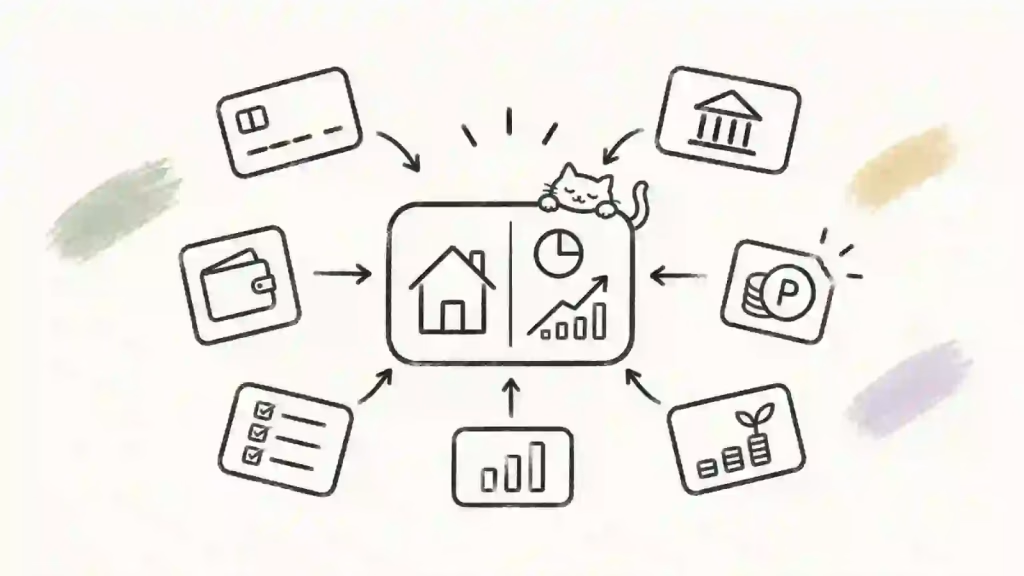
Credit-card rewards are only one part of a point ecosystem.
This comparison also looks at how easy the points are to use, how banking and brokerage services connect, and how well each setup can show the rest of the household finances.
Using information available as of September 2026, this article compares seven ecosystems: Rakuten Points, V Point, Ponta, PayPay Points, d Point, WAON POINT, and MUFG.
Maximum reward rates are useful, but many are conditional, so I do not rank the ecosystems by the biggest headline percentage alone.
Comparing the seven ecosystems
| Ecosystem | Main card / rewards | How the points can be used | Bank / brokerage | Household / asset management |
|---|---|---|---|---|
| Rakuten Points | Rakuten Card: 1% base | 1 point = ¥1 through Rakuten Pay and partner stores; also usable for point investing at Rakuten Securities | Rakuten Bank / Rakuten Securities | Rakuten Household Account Book can aggregate outside accounts |
| V Point | Sumitomo Mitsui cards: typically 0.5% base; up to 20% at eligible merchants with conditions | 1 point = ¥1 for bill credits or V Point Pay; also usable for point investing at SBI Securities | SMBC / SBI Securities | SMBC app + Money Forward ME |
| Ponta | au PAY Card: 1% base | Usually 1 point = ¥1 through au PAY and Lawson; also usable for point investing at eSmart Securities | au Jibun Bank / Mitsubishi UFJ eSmart Securities | Best supplemented with an external household ledger |
| PayPay Points | PayPay Card: 1% base; up to 1.5% with PayPay Step | 1 point = ¥1 in PayPay; also usable in the PayPay Securities mini app | PayPay Bank / PayPay Securities | PayPay Wallet is strong in-house; external household tracking has gaps |
| d Point | d Card: 1% base | 1 point = ¥1 through partner stores and d Barai; also usable for point investing at Monex | Docomo Bank / Monex | Best supplemented with an external household ledger |
| WAON POINT | AEON Card: 0.5% base, 1% at eligible AEON Group stores | 1 point = ¥1 across the AEON network | AEON Bank / Monex financial-product intermediation | iAEON plus an external household ledger |
| MUFG | MUFG Card: 0.5% base; up to 20% at eligible merchants with conditions | Up to ¥5 per point via selected redemptions or wallet routes | MUFG Bank / Mitsubishi UFJ eSmart Securities | Money Canvas + Moneytree |
How points are earned matters, but so does how naturally they fit back into everyday life.
The same reward rate can feel very different when one program lets you spend points directly while another requires a separate wallet or redemption step.
Household management varies in the same way.
Some ecosystems offer their own cross-provider view, while others make more sense with an outside service such as Money Forward ME or Moneytree.
A headline figure such as 20% also needs context.
Those maximums can depend on eligible merchants, payment methods, bank-account settings, family registrations, app entry, and other conditions.
The more aggressively you optimize, the more maintenance the setup requires.
Rakuten Points: a broad all-round ecosystem
| Item | Details |
|---|---|
| Main card | Rakuten Card (1% base) |
| Bank | Rakuten Bank |
| Brokerage | Rakuten Securities |
| Point uses | Rakuten Pay, Rakuten Point partners, Rakuten Securities, and more |
| Household finance | Rakuten Household Account Book can link outside banks, cards, and brokerages |
Rakuten still works well as a benchmark because cards, banking, investing, points, and household management are all present inside the same broad ecosystem.
The downside is optimization overhead.
SPU becomes increasingly complicated when you try to maximize every multiplier.
In 2026, it is also easier to keep Rakuten Points and Rakuten Securities while replacing only the bank with Mizuho and the Mizuho Rakuten Card, so there is less reason to force everything into Rakuten.
I cover that hybrid setup in From Rakuten Bank to Mizuho Bank: Is It Worth Moving a Household Main Account?.
References: Rakuten Card / Rakuten Point usage / Rakuten Securities point investing / Rakuten Household Account Book / Rakuten Bank Money Bridge
V Point: a strong combination of Olive and high card rewards
| Item | Details |
|---|---|
| Main card | Sumitomo Mitsui Card / Olive (typically 0.5% base on standard cards) |
| Major upside | Up to 20% at eligible convenience stores and restaurants when multiple conditions are combined |
| Bank | SMBC |
| Brokerage | SBI Securities |
| Point uses | Bill credits, V Point Pay, SBI Securities, and more |
| Household finance | SMBC app integrated with Money Forward ME |
V Point becomes easiest to understand when Sumitomo Mitsui Card or Olive, SMBC, and SBI Securities are used together.
At eligible merchants, smartphone contactless payments, Family Points, and the V Point Up Program can push the total reward rate to as much as 20%.
That is genuinely attractive, but it is also a good example of how the biggest number comes with the most conditions.
A 0.5% base rate and a 20% maximum should not be treated as the same kind of reward.
The Money Forward ME integration is also a sensible choice for household management.
One caveat: V Point Pay itself is not automatically imported by Money Forward ME, so asset aggregation and payment-history aggregation are separate issues.
References: Sumitomo Mitsui Card / Using V Points / SBI Securities point investing / SMBC app
Ponta: easy-to-use points with strong au integration
| Item | Details |
|---|---|
| Main card | au PAY Card (1% base) |
| Bank | au Jibun Bank |
| Brokerage | Mitsubishi UFJ eSmart Securities |
| Point uses | au PAY, Lawson, eSmart Securities, and more |
| Household finance | No strong first-party universal ledger; external aggregation is the natural choice |
Ponta has broad everyday uses through au PAY, Lawson, and other partners, which makes the points themselves easy to handle.
The ecosystem gets stronger when au telecom services and au Jibun Bank are included, while household tracking is better left to something such as Money Forward ME.
A practical way to think about it is: points, payments, bank, and brokerage can stay in the au sphere, while the household ledger sits outside it.
References: au PAY Card / Ponta at Lawson / eSmart Securities point investing / au Jibun Bank rate program / Money Forward ME au ID integration
PayPay: excellent in-app integration, but a household-ledger gap
| Item | Details |
|---|---|
| Main card | PayPay Card (1% base, up to 1.5% with PayPay Step) |
| Bank | PayPay Bank |
| Brokerage | PayPay Securities |
| Point uses | 1 point = ¥1 in PayPay; also usable in the PayPay Securities mini app |
| Household finance | PayPay Wallet is strong in-house; PayPay payment activity is not auto-imported into Money Forward ME |
PayPay puts payments, banking, points, and investing inside one app, so the ecosystem feels unusually cohesive when viewed from the inside.
PayPay Points can also be used directly in the PayPay Securities mini app, making the path from everyday spending to investing unusually natural.
The weakness appears when you try to track the whole household outside PayPay.
Money Forward ME supports PayPay Bank but does not automatically import PayPay payment activity.
If PayPay is your main everyday payment method, that missing transaction feed is surprisingly noticeable.
References: PayPay Card / PayPay Points / PayPay Securities point investing / PayPay Wallet / Money Forward ME support for payment apps
d Point: banking, debit, and Monex now form a stronger whole
| Item | Details |
|---|---|
| Main card | d Card (1% base) |
| Bank | Docomo Bank |
| Brokerage | Monex |
| Point uses | Partner stores, d Barai, Monex, and more |
| Household finance | No first-party universal ledger; external aggregation is the natural choice |
In 2026, the former Sumishin SBI Net Bank became part of Docomo's banking ecosystem, making the financial side of d Point much stronger.
Debit cards are also part of the appeal for me.
There are options such as the standard Mastercard debit and Point+, which makes the ecosystem interesting for people who prefer immediate debit from a bank balance instead of running everything through a credit card.
I wrote more about that switch in Why I Replaced Platinum Preferred with the Sumishin SBI Debit Point+ Card.
Household management still depends on outside services, and d Card integration had some instability as of September 2026.
That should be evaluated separately from the strength of the bank, debit card, and points themselves.
References: d Card / d Point / Monex d Point investing / Docomo Bank debit card / Money Forward ME d-service integration
WAON POINT: strong for everyday AEON spending
| Item | Details |
|---|---|
| Main card | AEON Card (0.5% base, 1% at eligible AEON Group stores) |
| Bank | AEON Bank |
| Brokerage | Monex financial-product intermediation |
| Point uses | 1 point = ¥1 in the AEON network and related WAON uses |
| Household finance | iAEON is oriented toward AEON services; external household aggregation fills the gap |
WAON POINT makes the most sense as a daily-life ecosystem rather than a finance-first ecosystem.
If a large share of groceries and household goods come from the AEON Group, the points naturally flow back into everyday spending.
References: Using WAON POINT / AEON Card point rates / Monex WAON POINT exchange / Money Forward ME WAON integration
MUFG: a strong card and household-finance layer, with less straightforward point usage
| Item | Details |
|---|---|
| Main card | MUFG Card (0.5% base) |
| Major upside | Up to 20% at eligible convenience stores, restaurants, supermarkets, and other merchants when conditions are met |
| Bank | MUFG Bank |
| Brokerage | Mitsubishi UFJ eSmart Securities |
| Point uses | Up to ¥5 per point through selected wallet or redemption routes; bill cashback is ¥4 per point |
| Household finance | Money Canvas, using Moneytree to aggregate outside accounts |
The MUFG Card starts at only 0.5%, but eligible merchants receive a 7% rate and the Point Up Program can push the total to as much as 20% when its conditions are met.
Like Sumitomo Mitsui Card, the upside at everyday merchants is genuinely strong.
The awkward part is what happens after the points are earned.
Global Points are not a simple 1-point-equals-¥1 currency, and extracting the maximum value involves a wallet or another redemption route.
That makes the point side feel less straightforward than Rakuten Points or PayPay Points.
Household management is the opposite: Money Canvas is strong, and its Moneytree integration lets it pull in outside banks, brokerages, cards, and other assets.
MUFG therefore has an unusual balance—strong card rewards and household management, but points that take a little more thought to use well.
References: MUFG Card / Up to 20% at eligible merchants / Global Point bill cashback / eSmart Securities card investing / Money Canvas household ledger
Conclusion: choose an anchor without over-optimizing
| If this is your priority | Ecosystem that fits naturally |
|---|---|
| You use Rakuten Ichiba and other Rakuten services frequently | Rakuten Points |
| You want to combine Sumitomo Mitsui Card / Olive with SBI Securities | V Point |
| You use au services and Ponta frequently | Ponta |
| PayPay is your main everyday payment method | PayPay Points |
| You want Docomo-linked banking, debit, and d Point together | d Point |
| A large share of household spending goes through AEON | WAON POINT |
| MUFG Bank and Money Canvas are your anchors | MUFG |
Every provider designs its rewards so that using more of its own services becomes more attractive.
The 20% maximums from Sumitomo Mitsui Card and MUFG Card are compelling examples, but the closer you get to the maximum, the more detailed the conditions become—and the more exposed the setup is to future rule changes or reward cuts.
A practical starting point is to choose one thing you do not want to change: a bank, a payment method, a supermarket, or a brokerage.
SBI Securities lets users register point programs including V Point, Ponta, and d Point, while choosing one as the main point program, so using SBI Securities alone does not mean you have to build the rest of the setup around V Point.
Then compare card rewards, how easy the points are to use, and household-finance integration, filling only the gaps with outside services.
One personal preference I do care about is whether accumulated points can eventually be put into mutual funds through a brokerage.
I would rather invest spare points than force myself to spend them just to use them up.
From that narrow perspective, Rakuten, V Point, Ponta, PayPay, and d Point work well for me, while WAON POINT and Global Points require more of a detour.
There is no need to capture every last reward.
If the setup fits everyday life, the points are easy to use, and household management does not become a chore, leaving a little reward on the table is fine.
The goal is to find a compromise you can live with and keep using the ecosystem without getting tired of managing it.
Interest rates, reward rates, program conditions, and external-service integrations are based on information available as of September 2026. These programs can change, so check the official sites before making decisions.





Comments