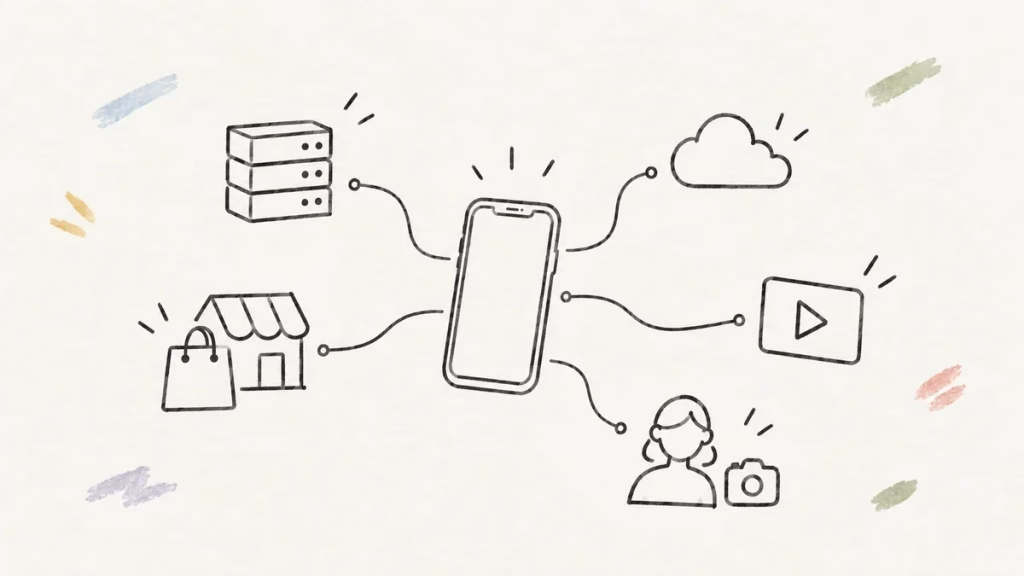
Lately, I have had the sense that advertising companies do not stand out quite as much as they used to.
That does not mean the advertising market has disappeared. Digital advertising is still a huge business.
But the work of running ads has changed considerably.
Google Ads, for example, has been expanding AI Max, which can handle tasks such as broadening search queries, generating ad copy, and selecting landing page URLs.
In 2026, Google also began moving older features such as Dynamic Search Ads toward AI Max, describing the shift as one from "manual maintenance" to "AI-powered growth."
Google: "We're upgrading Dynamic Search Ads to AI Max"
I used to work with ad operations—both publishing and buying—and I was interested enough in adtech to keep track of the companies in the industry.
This was the era when terms like DSP, SSP, ad network, and rewarded ads were everywhere, and companies built around smartphone advertising were going public one after another.
So what are the companies I kept seeing back then doing in 2026?
When I checked again after all these years, many of the names were still around, but quite a few of the companies behind those names had changed substantially.
In the 2010s, "how to deliver ads" had value
The players in internet advertising have changed repeatedly as technology and devices changed.
During the dot-com era, portals, banner ads, search advertising, and affiliate marketing grew.
On feature phones, official mobile sites, mobile advertising, and content billing became major markets.
Then smartphones arrived, and the amount of app inventory and ad space expanded rapidly.
That was when DSPs, SSPs, and ad networks became much more prominent.
There was real value in the technology itself: aggregating large amounts of inventory and using data to optimize who saw which ad, and at what price.
FreakOut, founded in 2010, launched what it described as Japan's first DSP, "FreakOut," in 2011.
Its corporate history still gives a fairly detailed account of what it was like to build an RTB market at a time when one barely existed in Japan.
Today, DSPs and SSPs feel like ordinary components of the advertising stack.
Back then, they were an industry in their own right.
Looking back, they have all become rather different companies
If you look at these companies with their old image still in mind, there are quite a few moments of: wait, this is what they do now?
| Company | What I associated it with then | Main direction in 2026 |
|---|---|---|
| F@N Communications | Affiliate marketing, mobile ads | Expanding from A8.net into fan and influencer marketing |
| ValueCommerce | Affiliate marketing | Marketing solutions, travel tech, new businesses |
| Adways | Affiliate marketing, app ads | Still centered on agency and ad-platform businesses |
| CARTA HOLDINGS | Media, adtech | Broader marketing, e-commerce, DX, data, and more |
| Geniee | SSP, DSP | Advertising platforms plus SaaS |
| MicroAd | Mobile ads, DSP, SSP | Data platforms and ad delivery |
| FreakOut | DSP | Advertising plus UUUM, sports, retail media, and more |
| i-mobile | Ad network | Consumer services led by Furunavi, alongside advertising |
| Speee | SEO, advertising, web marketing | Legacy-industry DX, financial DX, DX consulting |
| UNITED | Mobile ads, games | Investment, education, HR, adtech, and other businesses |
| Axelmark | Advertising, games | Advertising, IoT healthcare, blockchain, and more |
The details differ quite a lot from company to company, but many are no longer well described simply as "smartphone advertising companies."
Some stayed in advertising; others moved beyond it
Looking across them, one useful question is what each company turned the assets it gained from advertising into afterward.
Some expanded their customer relationships. Some built their own services. Others moved into SaaS, IP, or businesses much farther from advertising.
Adways is one of the clearer cases of a company that still looks very much like an advertising company.
It continues to position agency services and ad platforms as core businesses, with products such as UNICORN, JANet, and Smart-C.
MicroAd is also still very much on the advertising continuum.
Its business began inside CyberAgent, moved through DSP and SSP products, and today centers on the UNIVERSE data platform and ad delivery. Rather than leaving advertising, it looks more like a company that shifted the source of value from delivery technology toward data.
CARTA HOLDINGS and Geniee are different again. They did not abandon advertising so much as use it as an entry point into a broader range of work.
CARTA now covers integrated marketing, e-commerce support, LINE-related services, TV commercials, retail DX, and venture capital.
Geniee operates both advertising and SaaS products, and says it had more than 6,800 active client companies across those products as of February 2026.
The direction is fairly clear: do not stop at ad operations; move further into the customer's marketing and sales activity.
i-mobile took another path.
It has been in internet advertising since its founding in 2007, but Furunavi, the hometown-tax donation service it launched in 2014, became a major pillar of the business.
Today the company has two segments, "Consumer" and "Internet Advertising," with travel and point services also included on the consumer side.
i-mobile: Message from Management
It is a particularly easy example to understand: take the customer-acquisition and marketing capabilities built in advertising and apply them to your own service.
As a way of building "what comes after advertising," it makes a lot of sense.
Speee and UNITED made me think, "they went that far?"
Speee's current businesses are DX consulting, legacy-industry DX, and financial DX.
Its scope ranges from matching services in real estate, renovation, and nursing care to blockchain-based financial infrastructure.
UNITED now has a portfolio that includes investment, private tutoring, recruitment, designer matching, web and app development, sports DX, advertising, and games.
If your mental picture is still "the mobile advertising and games company," the current UNITED is a bit of a surprise.
It is especially hard to describe the company today using only that old image.
FreakOut expanded from ad delivery into "people"
The company whose transformation I found most interesting was FreakOut, because it has changed substantially while still making sense once you trace the line.
The company remains in advertising.
At the same time, it made UUUM a consolidated subsidiary in 2023 and then a wholly owned subsidiary in 2025.
In 2026, athlete-management company UDN SPORTS also became a consolidated subsidiary.
A company that started as a DSP now has creators and athletes inside the group.
At first glance, that looks like it has traveled quite a long way.
But through the lens of advertising, the connection is not all that strange. The company expanded from technology for efficiently buying ad inventory toward relationships with creators and athletes who themselves carry advertising value.
It moved from ad "delivery technology" toward media and people around advertising.
That seemed surprisingly coherent once I looked at it that way.
A8.net was still the core business more than 25 years later
F@N Communications impressed me in a different way.
A8.net launched in 2000.
Even in 2026, the company still describes A8.net as its core business.
Its official IR FAQ likewise describes A8.net, a performance-based platform connecting advertisers and media members, as its "core business."
And in May 2026, it announced a complete redesign of the media-member dashboard, with "smartphone support" highlighted as one of the major changes.
A8.net: Media Dashboard Redesign
"Smartphone support" in 2026 is quite a phrase.
Even so, A8.net also announced that it had ranked first in affiliate-user satisfaction for the 16th consecutive year in a 2026 survey.
A8.net: No. 1 in Affiliate Satisfaction for 16 Consecutive Years
It is a useful reminder that the strength of a technology company is not always the newest technology.
There are advertisers.
There are publishers.
There is a deep pool of offers.
And there is a long-established system for attribution and payments.
In A8.net's case, the "market" itself became an asset, not just the software underneath it.
That is a different kind of strength from constantly chasing the latest technology, and it has proved remarkably durable.
Expanding into adjacent areas, or searching for the next pillar
ValueCommerce, which launched its affiliate service in 1999, took a somewhat different route.
Its current investor materials position marketing solutions, travel tech, and new businesses as major strategic pillars.
ValueCommerce: Corporate History
ValueCommerce: Investor Relations
Rather than simply defending an old performance-advertising business, the company has expanded closer to the point of purchase, into areas such as e-commerce, CRM, and retail media.
Axelmark, meanwhile, still operates advertising businesses including the ADroute ad network, a DSP, a trading desk handling Google and social ads, and e-commerce support, while also listing IoT healthcare and blockchain-related businesses.
Axelmark: Advertising Business
There is a visible difference between expanding into adjacent areas close to purchasing, as ValueCommerce has done, and searching for the next pillar through businesses much farther from the core, as Axelmark has.
The latter, to be frank, looks much more like a company still searching for that next pillar.
That does not mean the adjacent route is easy. If a business depends heavily on platforms or a small number of large customers, changes in their policies can still have a major effect.
Advertising companies sit between businesses and media, so wherever they expand, the difficult question remains: what can they actually own as an asset?
The changes were not only about diversification
Among the companies I revisited, many of the survivors kept their corporate names while changing what they did.
But that is partly because I was looking mainly at listed companies that survived. In Japan too, companies such as FIVE were acquired by large platforms and ultimately folded into broader advertising infrastructure. FIVE became a wholly owned LINE subsidiary in 2017, and in 2020 it disappeared from NAVER's consolidated-subsidiary list as a result of a merger.
LINE: FIVE Inc. to Become Wholly Owned Subsidiary of LINE Corporation Through Capital Alliance
There was consolidation overseas as well.
Magnite is an easy example: Rubicon Project and Telaria merged in 2020 to create the company, and in 2021 Magnite acquired video-ad company SpotX for approximately $1.14 billion.
Magnite: Rubicon Project and Telaria Complete Merger
Magnite: Magnite Closes SpotX Acquisition
Some companies survived by diversifying. Others became part of consolidation.
Either way, we are far from the 2010s, when a DSP or SSP itself could be the entire growth story.
Advertising companies sit in the middle, so they keep searching for the next source of value
After going through these companies, it becomes easier to see why so many of them keep looking for the next pillar.
Advertising companies have traditionally created value by connecting a client's products and services with media and platforms.
When ad-delivery technology becomes standardized, or when platforms such as Google and Meta automate more of the work, some of the value that used to belong to people and specialized tools moves into the platform itself.
What companies tried to own next differed.
Their own consumer services. SaaS. Media and IP. Investment and unrelated businesses.
Or, in A8.net's case, a network built over decades and continuously maintained.
Seen this way, this is not only a history of advertising companies.
It may be more about what happens to companies in the middle when technology shifts where value sits—and whether they can turn something from the old layer into an asset of their own.
AI is now shifting the value of ad operations
And in 2026, the next shift is AI.
Google is expanding AI Max across search and shopping advertising, while adding more agent-like functions to Google Ads and Google Analytics.
Google: Google Marketing Live 2026
I do not think AI means advertising companies themselves become unnecessary.
But bidding, targeting, ad-copy generation, and analysis—the work of "running ads well"—seem likely to become less exceptional skills than they once were.
If that continues, the things that carry more value may be assets outside ad operations: customer data, sales channels, first-party information, brands, and IP.
Many of the companies that were "smartphone advertising companies" in the 2010s had already started looking for "what comes after advertising" long before AI arrived.
Every new technology wave changes where advertising companies place their value rather than simply making them disappear.
The dot-com boom, feature phones, and smartphones all changed the cast of players.
AI will probably do the same.
Ten years from now, I suspect I will once again be looking at today's marketing companies and asking, "Wait, what kind of company is this now?"


Comments