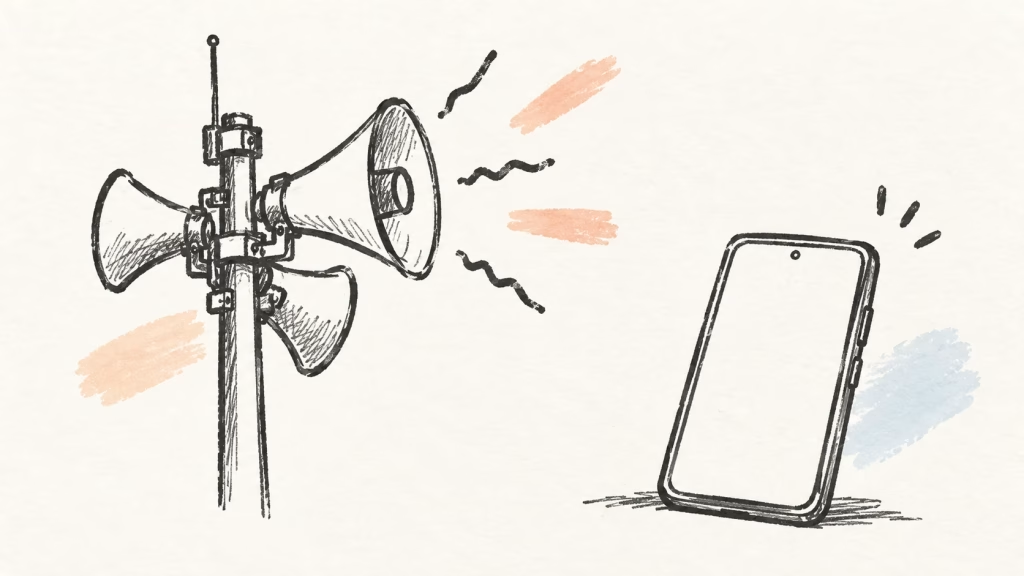
On October 16, 2026, a piercing alarm sounded from an outdoor public emergency loudspeaker. An announcement followed, warning of a potentially massive earthquake.
My phone, meanwhile, did nothing. No emergency alert sound, no notification. With such an urgent warning coming from outside, the silence on my screen seemed strange.
I soon learned that NTT Docomo had experienced a problem delivering earthquake alerts that day. My mobile plan is with IIJmio, using Docomo's network.
I had already been considering a change to au or SoftBank's network. Mobile speeds had been frustrating, and I'd seen plenty of complaints about Docomo's network quality. The missed alert gave me another reason to revisit my connection—and how I receive emergency information.
What happened to Docomo's earthquake alerts?
According to NTT Docomo's announcement, the company failed to distribute its Area Mail earthquake alerts at around 12:40 p.m. on October 16, 2026, following an earthquake near the Kamchatka Peninsula.
Docomo attributed the failure to a problem in its own systems. At the time of the announcement, it had identified the cause but warned that alerts might still fail until the issue was resolved. The earthquake warning itself was later canceled. Had a major earthquake actually been imminent, losing even a little time to respond could have mattered.
Public warning loudspeakers and mobile emergency alerts use different delivery paths. The Japan Meteorological Agency's guidance explains the ways people can receive earthquake early warnings, so hearing an outdoor alert while receiving nothing on a phone is entirely possible.
I haven't independently established why my particular handset remained silent. Still, Docomo's reported failure was enough to make me reconsider relying on a single alert channel.
IIJmio offers an au option without changing providers
I use IIJmio's Giga Plan on its Type D service, which runs on Docomo's network. IIJmio also offers Type A, using au's network.
According to IIJmio's guidance, eligible voice plans can switch network types and SIM formats while keeping the same phone number.
Switching to SoftBank's network would mean moving to another provider. With au, I can stay with IIJmio, which makes it an easier option to try.
Comparing IIJmio Type D and Type A
| Feature | Type D | Type A |
|---|---|---|
| Mobile network | Docomo | au |
| Giga Plan voice SIM monthly price | Same | Same |
| Voice eSIM | Supported | Supported |
| Emergency alert delivery network | Docomo | au |
IIJmio's published pricing does not distinguish between the two network types for equivalent voice plans. I used to think Docomo was a little cheaper, but I may have been remembering the different pricing for data-only eSIM plans.
As for speed, the mobile network is only part of the picture. IIJmio's own interconnection capacity and congestion also affect performance. I won't know whether Type A is faster where I actually use my phone until I try it.
Still, there is no monthly price difference, and my existing speed frustrations now sit alongside the earthquake alert incident. Type A seems worth trying.
Why I'm considering an eSIM on the Xiaomi 15T Pro
My phone is a Xiaomi 15T Pro. I could switch to au and continue using a physical SIM, but I'm also considering a move to eSIM.
With eSIM, I wouldn't have to remove and insert a small plastic card, and the physical SIM slot could remain available for another line. A physical SIM does have one clear advantage, though: moving it to another phone is usually as simple as swapping the card.
IIJmio may require a new eSIM profile when changing phones. For Type A, its regular profile issuance fee is ¥220. According to IIJmio's SIM exchange information, switching from a physical voice SIM to a Type A voice eSIM normally costs ¥2,200 for the exchange plus ¥220 for profile issuance—a total of ¥2,420. Promotional discounts depend on the conditions in effect when applying.
It feels a little unfortunate to pay a reissuance fee for a format that avoids a physical card and delivery. Even so, the convenience of not handling SIM cards makes au voice eSIM the option I'm leaning toward.
I haven't made the switch yet, so I can't report an actual activation time or setup results on the Xiaomi 15T Pro. I'll need a working Wi-Fi connection and should plan for a possible interruption while activating the new line.
Checking how I receive emergency warnings
Moving to au doesn't eliminate the possibility of another network failure. In this case, the warning I actually heard came from a public loudspeaker, which is a good reminder to look beyond the phone's cellular network.
Check the phone's emergency alert settings
On Android, searching Settings for terms such as “emergency alerts” or “wireless emergency alerts” is a good starting point. Check whether alerts and their sounds are enabled.
Even with the right settings, reception is not guaranteed. The Japan Meteorological Agency notes that device compatibility, settings, and reception conditions can affect alert delivery.
Add a disaster notification app
Apps such as Yahoo! Disaster Alert (Yahoo!防災速報) and NERV Disaster Prevention provide another way to receive information over the internet rather than relying solely on carrier-delivered emergency alerts.
These notifications also depend on connectivity, notification permissions, and the phone's battery restrictions. It's worth checking the alert region and permissions instead of merely installing an app and assuming it will work.
Keep another network—or another information source—available
Using two SIMs from different networks may help you stay online if one carrier has an outage. It does not guarantee two copies of every earthquake alert; that depends on the device and how its lines are managed.
TV, radio, public warning systems, and a charged power bank remain useful backups. It's also worth discussing family contact plans and learning about Japan's disaster message service, 171, before an emergency.
More than one way to get the warning
Hearing the outdoor warning while my phone stayed silent left me uneasy.
I'll probably give IIJmio's au-based Type A service a try. But changing carriers isn't a complete disaster preparedness strategy: every network can fail.
This time, it was the outdoor warning system that got my attention. The broader lesson is to have more than one way to receive information when it matters.

Comments