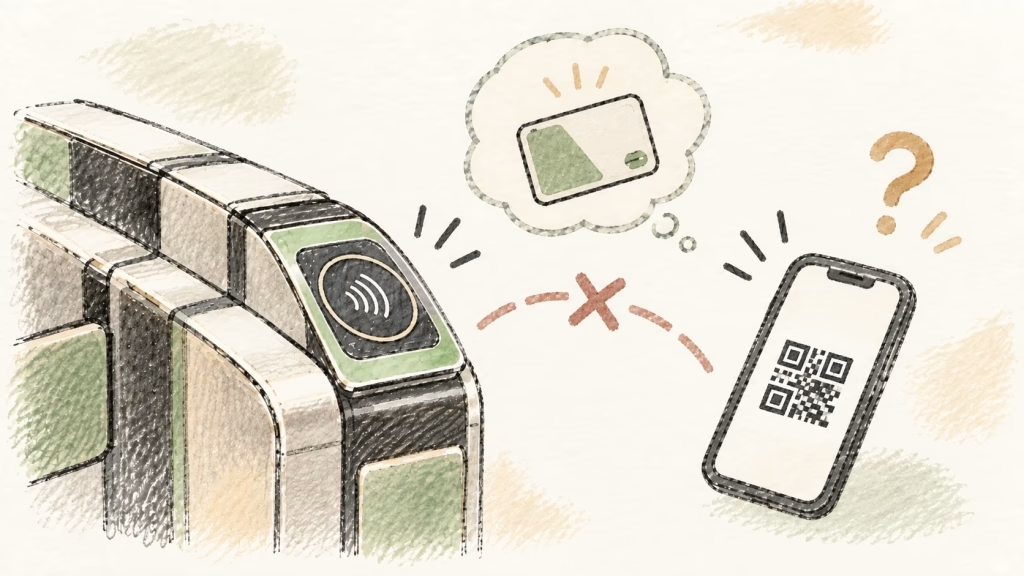
On October 20, 2026, JR East launched teppay, a new QR and barcode payment service integrated into its Mobile Suica app. It introduces features that Suica's ¥20,000 stored-value limit has long made difficult, including larger purchases and transfers between users.
I have generally preferred Suica over PASMO. I find its credit-card integration and app experience better, and being able to travel on the Shinkansen without a paper ticket is genuinely useful. But there is one restriction I've wanted to escape: choosing an Android phone partly because it supports Japan's Osaifu-Keitai and Mobile Suica.
A new payment product from JR East sounded like an opportunity to move beyond that limitation. Instead, teppay is an additional wallet alongside Suica—not the FeliCa-free successor I had hoped for.
What teppay can and cannot replace
It helps to compare teppay not only with Suica, but also with contactless credit cards and PayPay.
| What you want to do | Mobile Suica | teppay | Contactless credit card | PayPay |
|---|---|---|---|---|
| Enter railway gates directly | On supported routes | No | Only where accepted for transit | Generally no |
| Pay in stores | Transit IC merchants | teppay / Smart Code merchants, not necessarily Suica merchants | Merchants accepting your card network | PayPay merchants |
| Pay at checkout | NFC tap | QR / barcode | NFC tap | QR / barcode |
| Spend over ¥20,000 | Not from Suica balance | Subject to limits and eligibility | Subject to card limit | Subject to payment-method limits |
| Use a non-FeliCa Android phone | Not for Mobile Suica | Not for in-app code payment under current Suica setup requirements | On compatible devices | On compatible devices |
A shop displaying a Suica logo does not automatically accept teppay. The services use different merchant networks. And despite being a payment service from the railway operator, teppay's QR code is not a train ticket.
JR East describes teppay's features as including payments, transfers, charging Suica and purchasing eligible railway products. With the required verification, payments from a teppay balance can reach ¥300,000. Payments through a linked View Card instead depend on the card's available credit limit. Neither changes Suica's own ¥20,000 balance ceiling.
The distinction matters for trains. You cannot tap a gate using teppay balance directly. For ordinary pay-as-you-go Suica travel, you must first transfer funds to Suica. However, eligible products such as Ekinet tickets, Mobile Suica commuter passes and Green Car tickets can be purchased directly using teppay balance. Those are separate from using teppay as a fare medium at the gate.
A QR wallet that still needs Mobile Suica
According to the teppay FAQ, its code-payment feature requires a Suica to be set up on the device; moving all Suica cards back to the server disables that feature. The teppay JCB prepaid card has a separate exception.
That feels particularly restrictive when compared with a typical code-payment app. PayPay's device requirements cover supported software and authentication, but do not require an Osaifu-Keitai-compatible phone.
QR and barcode payments do not inherently require FeliCa. The restriction seems to follow from how the service is bundled into Mobile Suica, rather than from the underlying payment technology. Integrating it into an app existing users already have is convenient, but it also excludes people who might otherwise have adopted the new service.
And managing two balances in one app is still managing two balances. Instead of reducing the number of payment systems I need to think about, teppay adds another.
NFC does not mean every kind of tap works
Android phones may support contactless card payments without supporting Mobile Suica. That is because NFC describes several technologies, not a single interchangeable payment system.
As the NFC Forum specifications explain, NFC-A and NFC-B are commonly associated with the technology behind international contactless payment cards, while NFC-F is associated with FeliCa and services such as Suica.
FeliCa is part of the NFC family, not a technology outside it. But even a phone that can read NFC-F is not necessarily able to act as a Mobile Suica card. Secure hardware, software and service requirements also matter.
FeliCa helped make Japan's fast, convenient station gates possible. I appreciate that achievement. I just wish continuing to use Suica did not constrain my next phone purchase.
The teppay I actually wanted
Rather than a second way to pay, I would have liked an evolution of the original Suica experience.
| Capability | Today's teppay | My ideal teppay |
|---|---|---|
| QR / barcode payment | Supported | Supported |
| Tap payments at shops and gates | Not directly from teppay balance | Supported through multiple NFC approaches |
| Android without FeliCa | In-app code payment unavailable under current requirements | Supported |
| Larger payments | Up to ¥300,000 from verified teppay balance; linked View Card payments follow the card limit | Supported |
| Railway travel | Charge Suica for ordinary gate taps; buy eligible tickets directly | One account or wallet for direct travel |
| Shinkansen and commuter passes | Eligible products can be purchased with teppay balance | Integrated booking, tickets and passes |
| Existing Suica | Coexists | Remains as a compatible option |
This is a wish list, not a description of an announced roadmap. It would be wonderful to use QR or NFC for purchases, take trains, and manage the balance in one place without needing to understand which wallet is currently active.
Of course, this is not a simple software update. Traditional Suica gates cannot suddenly accept a non-FeliCa phone. JR East would need alternative authentication methods, compatible gate equipment, and the back-end infrastructure for complex fares, transfers, commuter passes and outages.
I understand why extending Mobile Suica is easier than replacing a vast operational system. Still, it would have been encouraging to see a path toward less FeliCa dependency—even if that began at only a handful of stations.
I like Suica, but convenience is why I use it
For everyday shopping, contactless cards and QR payments already cover most of my needs. I still choose an Osaifu-Keitai phone largely because I want Mobile Suica.
If contactless credit-card boarding eventually covers the trains I use, including longer-distance routes, that reason may disappear. Which makes teppay a missed opportunity: I wanted a new reason to stay with Suica, not another wallet to manage.
Meanwhile, JR East has announced that the Suica Penguin mascot will retire in March 2027. Replacing a familiar character while the phone compatibility restriction remains is an oddly revealing contrast.
Branding and railway infrastructure clearly have different costs and constraints. Even so, as a customer, I cannot help thinking: that is not the part of Suica I was hoping they would change.
I like Suica. But the reason I use it is convenience, and if a more convenient option arrives, I may switch. I hope JR East eventually builds a Suica experience that does not dictate which smartphone I buy.



Comments