I used to have a Lawson Ponta Plus credit card, issued by Lawson Bank, with issuance-related operations outsourced to Mitsubishi UFJ NICOS.
Its rewards were good enough that I could live with a cardholder website I wasn't particularly fond of.
Then the reward conditions changed substantially. To keep earning a decent return, I reluctantly switched to a Mitsubishi UFJ Card and opened an account at Mitsubishi UFJ Bank.
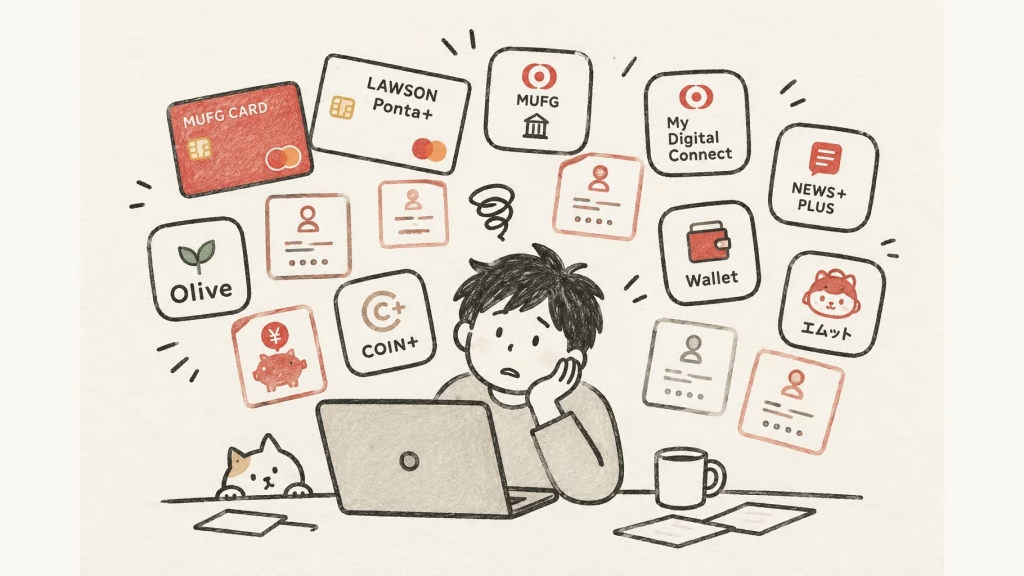
Although the two cards have different issuers, both involve Mitsubishi UFJ NICOS and use the same online account service, My Digital Connect. Naturally, I assumed I could manage them under my existing login. Apparently not: each card requires a separate ID, as the official FAQ explains.
A new card, and another login ID?
That discovery sent me looking into the rest of the group's services. Things became rather more complicated than I expected.
My Digital Connect. And NEWS+PLUS?
My Digital Connect (MDC) is the website where cardholders check statements and payment options.
The name sounds modern; the interface, to my eye, feels rather dated, and navigating it isn't especially pleasant.
The account model bothers me more than the appearance.
According to another official FAQ, you can use the same password for different cards, but you cannot consolidate their login IDs.
Rather than a single customer with several cards, the arrangement presents users with separate credentials for each card agreement.
The MDC mobile app does offer ways to manage multiple cards, which is helpful. But viewing several cards in one app isn't the same thing as having one identity across the service.
Then there's the login process itself. The official instructions tell users trying to access My Digital Connect to go to “NEWS+PLUS.”
Hang on. I wanted my credit card statement. Why am I going to NEWS+PLUS?
NEWS+PLUS appears to have served as a portal for cardholder news and promotions.
I can imagine how that evolved into a gateway for account management. What I struggle to see is why customers should need to know the history of a promotional portal to find their statements.
Given the name alone, would you guess it led to a card management login?
Some of the account-registration instructions add to the unease.
The registration procedure for former DC Card customers includes checks using a birth month or the last four digits of a telephone number, alongside other information.
Such details aren't necessarily secrets known only to the cardholder. Adding a field doesn't, by itself, make an authentication flow robust multi-factor authentication.
That procedure alone doesn't establish that the service as a whole is insecure. Still, a confusing collection of legitimate login destinations is hardly reassuring.
My personal preference would be to retire NEWS+PLUS as a separate destination and bring its useful promotional content into MDC.
And Then There Are All the Other Services
Once you include the bank, the list grows.
| Service | Main role |
|---|---|
| NEWS+PLUS | Cardholder news, promotions, and login entry point |
| My Digital Connect | Online management for supported credit cards |
| Net Branch | Online management for NICOS-branded cards |
| MDC app | Mobile card management |
| NICOS Card app | Mobile management for NICOS cards |
| Mitsubishi UFJ Direct | Online banking via the web |
| Mitsubishi UFJ Bank app | Mobile banking and access to group services |
| Easy Procedures app | Certain banking changes and administrative procedures |
| Smart Account Opening | Bank account application |
| Emutto | The group's integrated financial-service brand |
| COIN+ | Payment and money-transfer infrastructure |
| Air Wallet | An app using COIN+ |
| Global Point Wallet | A payment app using converted credit-card points |
This is a selection of consumer-facing services, not a claim that each has its own login system or that every customer uses all of them. Availability depends on the product and card.
The separate apps for banking procedures and opening an account also leave me wondering why customers need to distinguish between so many entry points.
To be fair, address changes are already supported in the main Mitsubishi UFJ Bank app, while a separate procedure app also serves customers without internet banking.
Those are valid reasons to support different workflows. I'd still prefer the main app to guide eligible users to the right procedure, without making them keep track of which app does what or install single-purpose apps unnecessarily.
And this is only the banking and credit-card side of the group. Add brokerage and trust banking and the picture grows more complicated still.
There are valid reasons for different products to have different functions. The problem begins when customers must understand the company's brand and system boundaries before they can decide where to go.
The historical layers matter, too. MUFG Card, DC Card, and NICOS have different origins, and some distinctions still show up in today's services.
For someone arriving as a new customer, that history isn't particularly helpful.
Emutto: Finally, One Place for Everything?
In 2025, Mitsubishi UFJ Financial Group introduced Emutto as an integrated financial-services brand.
It builds primarily around the Mitsubishi UFJ Bank app, making it easier to access banking, card, and investment-related services.
I welcome the direction. Yet a mobile-app hub is not the same as a fully unified service.
There isn't an equivalent, all-purpose desktop web experience for managing bank accounts, credit cards, and investments end to end. Detailed card settings can still take customers back to existing cardholder services.
That's a meaningful distinction.
I don't just check my account balance on a phone. When reviewing statements side by side, exporting data, or changing settings, a desktop browser can be substantially more comfortable.
Putting more links inside a bank app doesn't necessarily make the underlying maze disappear.
Why Add Global Point Wallet When COIN+ Already Exists?
The payments side has another curious overlap.
COIN+ is a payment and funds-transfer service involving Mitsubishi UFJ Bank and Recruit. It is used through apps such as Air Wallet for charging, paying, withdrawing, and moving funds; the bank app also provides access to COIN+-related functions.
Separately, Mitsubishi UFJ NICOS launched Global Point Wallet in June 2025.
It lets users convert credit-card reward points into a prepaid balance and spend using options such as Visa contactless and QUICPay+.
COIN+ and Global Point Wallet differ in their operators and payment mechanisms. Simply merging them may not be feasible.
But as a customer, I find myself wondering: to spend my points, do I really need yet another wallet? Which app am I supposed to use?
Creating an account for a financial service demands more care than signing up for a typical website.
There may be identity checks, linked accounts and cards, stored balances, recovery procedures, fraud considerations, and the question of what to do when you stop using it.
Even an app you rarely open remains one more thing to manage.
There are other conceivable approaches: make it easier to apply points directly toward card bills, or explore integration with an existing payment service.
Was another standalone app the best answer from the customer's perspective? I'm not convinced.
A History of Mergers and Additions
Mitsubishi UFJ NICOS has roots in Nippon Shinpan, UFJ Card, and DC Card.
Putting those businesses together was one thing. Consolidating their brands, customer systems, and authentication was always going to be more complicated.
It's not fair to say no consolidation has happened.
In 2025, work progressed on integrating systems for DC and MUFG cards, including moving former DC Card web functions toward My Digital Connect.
The company has undertaken real work behind the scenes.
But backend consolidation doesn't always translate into less complexity for the customer.
If the website still assigns an ID to every card, the everyday experience may remain largely unchanged.
What follows is speculation, not a description of MUFG's actual organization.
In a long-established company, individual divisions may each have sound reasons to launch services, while group-wide brands and cross-service links are introduced later.
Viewed in isolation, each project has a purpose. Taken together, the result can be a growing collection of overlapping entrances.
Retiring or consolidating a service can be harder than creating it: technology is only part of the issue, alongside organizational structures, contracts, and how success is measured.
Adding Features Isn't the Same as Improving the Experience
For a brief contrast, Sumitomo Mitsui Banking Corporation's Olive attempts to bring banking and cards into a more connected experience through shared services such as SMBC ID.
It isn't completely unified either: Vpass ID linkage remains part of the process.
I'm less interested in declaring a winner than in asking how much of a financial institution's internal structure its customers need to understand.
More apps mean more functions. Downloads and new registrations are relatively easy to count.
But if users are also accumulating login credentials, stored balances, and places to check, has life really become simpler?
A Good Service Has to Keep Changing
The longer a service exists, the more of its past design decisions it carries.
An arrangement that once made sense may deserve reconsideration as technology, habits, and customer needs evolve.
That isn't an argument for indiscriminately deleting old systems.
Keep what still works. Combine overlapping functions. Gradually close entrances that have outlived their purpose. Introduce new technology when it genuinely improves the experience.
And make those decisions across the service as a whole, not one app at a time.
Financial migrations do need caution. Abruptly shutting down systems and abandoning existing customers would create another set of problems.
Still, an integration initiative like Emutto sets an expectation.
I would like to see not only more capabilities accessible from a common hub, but also fewer logins and fewer unnecessary distinctions to remember.
This began with one more credit card and one more ID. It led through portals, apps, wallets, and a surprising number of brand names.
Adding useful services isn't necessarily the same thing as creating a useful experience.
Perhaps the mark of a good service isn't how many new features it keeps accumulating, but how well it continues to change with the times.
References
- Mitsubishi UFJ NICOS: IDs for multiple credit cards
- Mitsubishi UFJ NICOS: Passwords for multiple cards
- Mitsubishi UFJ NICOS: MDC login instructions
- Mitsubishi UFJ NICOS: Registration process for former DC Card customers
- Mitsubishi UFJ NICOS: Global Point Wallet announcement
- SMBC: Olive and Vpass ID linkage




Comments